The 1600 number mandate: what regulated callers in India need to know
· Updated · 7 min read · The SMSAPI team
A 1600 number is the dedicated outbound numbering series for transactional and service calls from regulated financial entities in India. Under a TRAI direction issued in December 2025, commercial banks had to start calling from 1600 numbers from the start of January 2026, with other banks, NBFCs, insurers, SEBI-registered firms and PFRDA entities following in later phases.
When a bank calls a customer about a payment, the call too often goes unanswered for the same reason a spammer's does: an unfamiliar number reads as a risk, and people have learned to let those ring out. India's answer to that, for regulated callers, is a dedicated numbering series that begins with 1600 — a range a customer can recognise as a genuine, registered business call rather than a sales pitch or a scam.
If you operate in banking, insurance, securities or pensions, the 1600 series is no longer optional, and the early phases of the timeline are already in force. Here is what the mandate covers, who it reaches, and what moving onto it does for your call performance.
What is a 1600 number?
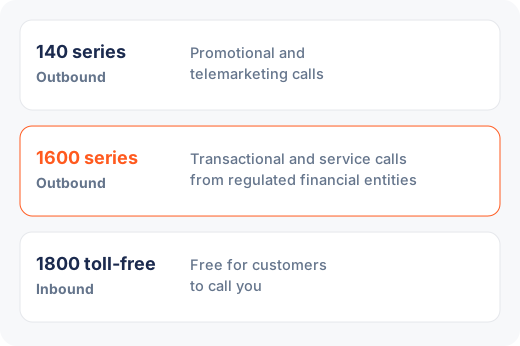
India separates commercial calling into recognisable lanes. The 140 series marks promotional and telemarketing calls. The 1600 series marks transactional and service calls from regulated financial entities: the bank confirming a transaction, the insurer flagging a lapsing policy, the fund house reading out a folio update. The point is identification. A customer who sees a 1600 number knows the call comes from a registered entity that has passed know-your-customer checks with its operator, and a complaint about that call can be traced back to a real, accountable sender.
That traceability is the regulatory intent. For your customers, the series does something simpler and more valuable: it tells them the call is worth answering.
1600 is not 1800: outbound identity versus inbound access
It is easy to conflate the two ranges, because both signal a real business. They solve opposite halves of the call. An 1800 toll-free number is inbound: it is free for a customer to call you, and it is about access. A 1600 number is outbound: it is the identity you call from, and it is about recognition and traceability on the calls you start. A regulated entity typically wants both: a 1600 series for the calls it makes and an 1800 line for the calls it receives, and the two are provisioned and billed separately. If you are weighing which numbers your business should publish, the toll-free versus virtual number guide walks through the distinctions.
Who needs a 1600 number, and by when?
TRAI's direction applies to entities regulated by the RBI, IRDAI, SEBI and PFRDA, with deadlines staggered by category. The timeline it set runs broadly like this:
| Category | Includes | Move to 1600 numbering from |
|---|---|---|
| Commercial banks | Public, private and foreign banks | The start of January 2026 |
| Large NBFCs, payments banks and small finance banks | NBFCs with asset size above ₹5,000 crore | Early February 2026 |
| Insurers | IRDAI-regulated insurers, across the general and life segments | The middle of February 2026 |
| Remaining NBFCs and smaller banks | NBFCs at or below ₹5,000 crore, co-operative banks and regional rural banks | The start of March 2026 |
| SEBI-registered firms | Mutual funds, asset managers and qualified stockbrokers | The middle of March 2026 |
| Other SEBI-registered intermediaries | Registered intermediaries beyond the firms above | Following the mid-March 2026 phase |
| PFRDA entities | Central recordkeeping agencies and pension fund managers | A later phase |
Because these dates have now passed for the early categories, the practical question is not whether you will need a 1600 number but whether your current calling already complies. Confirm your own category's status directly with your operator, since the rollout is applied per segment and the detail matters more than the headline date.
What happens if you keep calling from an ordinary number?
The direction is not advisory. An entity that keeps making regulated outbound calls from ordinary mobile or landline numbering, after its deadline, is treated as an unregistered telemarketer when a customer files an unsolicited-call complaint. That carries the exposure any unregistered sender faces: calls flagged, traffic blocked, and the registrations the business depends on put at risk. For a regulated financial entity, being classed alongside spam callers is also a reputational cost that outlasts any single penalty.
Why a recognised number is worth more than compliance
The mandate is a requirement, but the reason it works in your favour is answer rate. A call from a number a customer cannot place is a call screened out before it is heard — and for time-sensitive contact like a fraud alert, a missed-payment reminder or a maturity notice, an unanswered call is a failed one. A 1600 number that customers come to recognise gets picked up more often, which means fewer repeat-dial cycles, fewer fallbacks to other channels, and a real conversation at the moment one matters.
The number pairs naturally with the rest of a compliant calling setup. Route it through an IVR or voicebot so callers reach the right team without a maze, record calls with consent for audit, and keep a toll-free number on the inbound side so a customer who misses your call can ring back at no cost. For outbound contact that is service rather than sales, the same discipline that governs voice broadcasting applies: classify honestly, keep your consent records, and identify yourself in the first sentence.
Getting onto a 1600 number
A 1600 number is allocated through a licensed telecom operator, not bought off a shelf, and the setup mirrors what regulated callers already know from DLT: entity verification, paperwork against the regulator your firm answers to, and configuration of the IVR and recording that sit behind the number. If your team has been through DLT registration for SMS, the shape of the process will be familiar.
We provision and configure 1600 numbering for banks, NBFCs, insurers and SEBI-registered firms, including the IVR routing and call recording the mandate expects, and handle the operator paperwork as part of it. Pricing depends on the configuration and the regulator involved, so we quote it directly rather than publishing a single figure.
What to do now
If your firm is regulated by the RBI, IRDAI, SEBI or PFRDA, a short audit tells you where you stand:
- Find your category and its date. Match your firm to the list above and confirm the exact deadline with your operator, since it is applied per segment.
- Check what you call from today. If outbound customer calls still originate from mobile or landline numbers, you are exposed the moment your deadline passes.
- Allocate a 1600 number through a licensed operator, with the entity verification your regulator requires.
- Move your IVR and recording behind it, so routing, consent capture and audit logging all sit on the compliant number.
- Brief your calling teams to open with the firm's name and the reason for the call, which is what the number's identity promises the customer.
The short version
The 1600 numbering series is now mandatory for regulated outbound callers in India: commercial banks, NBFCs, insurers, and SEBI- and PFRDA-registered firms, on a phased timeline that began in January 2026. Calling from ordinary numbering after your category's deadline gets you treated as an unregistered telemarketer. Moving onto 1600 is the requirement, but the payoff is practical: a number customers recognise gets answered, which is the whole point of calling them. Allocate the number through an operator, put your IVR and recording behind it, and confirm your category's current status before your next campaign.
Talk to our team if your outbound calling is still on ordinary numbering and you need to get compliant.